
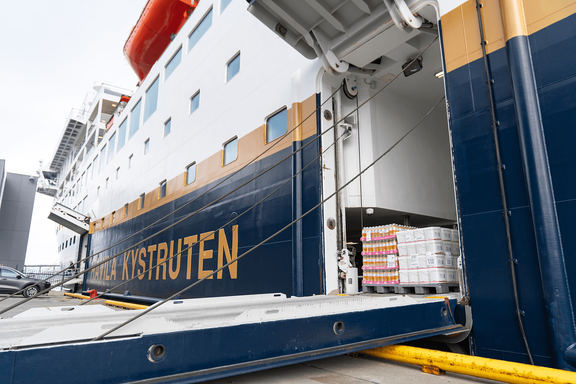
Havila Voyages, one of two operators on the historic coastal route Bergen – Kirkenes – Bergen under contract with the Ministry of Transport, is experiencing very strong growth in local passengers and cargo on board its four coastal vessels. From 2024 to 2025, the number of local travelers, who use the Coastal Route as a ferry, increased by a full 14%, while 11% more cargo was transported in 2025 compared with the previous year.
“This is very positive and shows that the coastal route and its public service mission remain just as important for local communities along the route,” said Bent Martini, CEO of Havila Voyages. “There was a natural decline in both local passengers and cargo during and after the pandemic, in addition to the unfortunate delays we experienced in bringing all four vessels into operation.
“This affected the figures at the start of the current contract period. With all ships now in stable operation along the coast, the service is more predictable, and it is gratifying to see this reflected in such strong growth.”
At the same time as the company has recorded positive results for the coastal route – and the state has gained more value from its service purchase – Havila Voyages has also submitted a proposal to the Ministry of Transport for route optimisation that would provide greater benefits for people along the coast in the years ahead.
“In December 2025, we held several dialogue meetings on board Havila Polaris along the coast to gain even deeper insight into the importance of the coastal route and the wishes people have for its future. In addition, we have received input from the business community and have read the consultation responses to the Oslo Economics report with great interest,” said Martini. “Across the board, the coastal route is described as a vital lifeline, and everyone we have spoken to wants to see it strengthened.
“This includes requests for longer port calls at ports that currently have very short visits, in order to handle cargo more effectively and to better accommodate local passengers.”
In the proposal submitted to the ministry, longer port calls are suggested at nearly all ports north of Bodø, in both the northbound and southbound directions. In Kirkenes, the port stay is to be extended significantly to better coordinate with air travel—something that has also been widely requested.
“We have delivered a proposal for the entire route, incorporating input from local communities, ports, and businesses, and laying the groundwork for increased port stays,” Martini explained. “We have presented the proposal to the ministry and hope it will be approved. If they say yes, it will have many positive consequences.
“Increased port stays primarily create greater societal benefit. Over time, several northern ports have told us that the ships do not stay long enough to load sufficient cargo, and that adjustments to the sailing schedule would enable far better connections with other transport modes, especially in Finnmark.”
Part of the solution is to optimise the flow along the entire coastal route, including reintroducing separate summer and winter schedules. The proposal also includes reduced sailing speeds on certain stretches, which will lead to lower fuel consumption and, in turn, reduced greenhouse gas emissions.
“This is a win-win-win solution that we are eager to implement,” Martini concluded. “With relatively small adjustments, we can take even better care of the unique natural environment we sail through and, not least, create even better conditions for local communities along the coast. We believe this should be easy to adopt. It is a strong example of how, even after 130 years, the coastal route continues to evolve and become increasingly important for the coast, also between contract periods.”
You can read more of the latest from the world of Marine here.