A first-of-its-kind project to develop a network of ocean robots to assure the successful operations of submersible fleet assets has launched this month, following a successful funding bid with UK Defence Innovation (UKDI), previously known as the Defence and Security Accelerator (DASA), between ZeroUSV, Oshen and MarineAI.
As underwater uncrewed assets (XLUUVs) are increasingly used and become part of the navy’s future fleet, a key future requirement is maintaining contact with and ensuring the status of underwater assets without relying on direct, high bandwith & detectable communications.
By deploying a constellation of Oshen’s robust C-Star vessels, the project creates a ‘passive acoustic network’ capable of picking up covert signals from platforms like the XV Excalibur.
The solution channels level 4+ autonomous deployment, passive acoustic sensing and distributed communications into a cohesive system, to deliver a novel and scalable means to support and enhance submersible operations such as critical national infrastructure monitoring, defence operations and environmental monitoring.
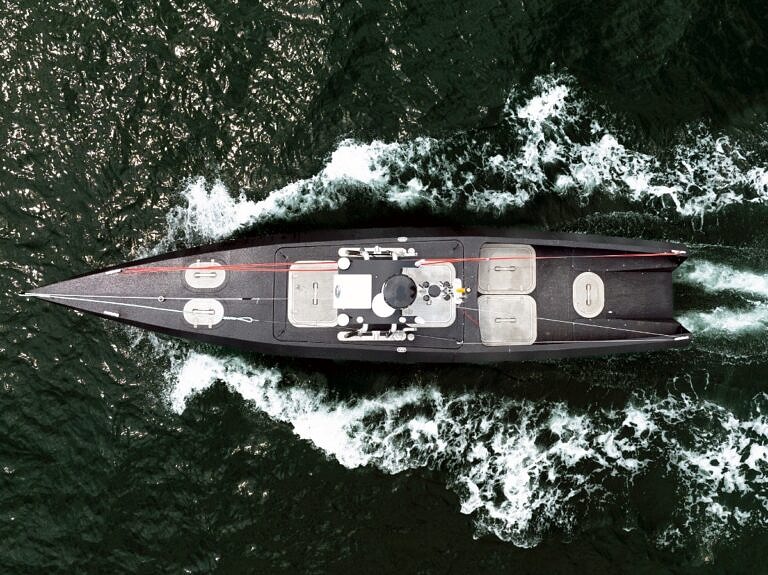
During the trials, ZeroUSV’s Oceanus12 will autonomously transport and launch a constellation of Oshen ‘C-Stars’ over an area of sea, to form a network of acoustic sensing that can pick up covert signals from XV Excalibur. MarineAI’s involvement will ensure the C-Star launch system is integrated with the GuardianAI suite onboard the Oceanus12.
The aim is to demonstrate a practical method for confirming asset presence and progress during underwater missions, including intelligence, surveillance and reconnaissance, seabed mapping and the monitoring of subsea infrastructure.
The complexity of multi-platform integration and co-ordinated autonomy goes beyond incremental improvement, proposing a new operational concept to support underwater operations for the Royal Navy and allied forces.
UK and allied defence forces utilise advanced submersible and seabed assets, such as XV Excalibur, to perform numerous key tasks, including persistent intelligence, surveillance, and reconnaissance (ISR) of national critical infrastructure sites such as key subsea cables or pipelines, future military date gathering (FMDG) campaigns to map key areas of seabed, as well as to perform anti-submarine warfare (ASW) missions.
“Underwater operations depend on knowing where assets are and whether they’re operating as intended, but direct communications aren’t always desirable or possible,” Matthew Ratsey, Co-Founder and Managing Director at ZeroUSV, said. “This project lets us explore a different approach, using Oceanus12 to place a small constellation of surface vessels that can listen passively and provide assurance without compromising the mission. We’re pleased to be working with Oshen and MarineAI under UKDI support to test the concept at sea and understand how it could strengthen future UK and allied operations.”
“Wide area, persistent monitoring only works if the sensing platforms are robust, simple to deploy and able to reliably complete durations over multiple months,” Anahita Laverack, CEO at Oshen, said. “C-Stars were designed for exactly that kind of role. In this project we are looking at how a constellation of C-Stars, deployed by Oceanus12, can form a practical acoustic network that supports key underwater missions. We welcome the chance to develop and prove the approach with ZeroUSV and MarineAI under UKDI support.”
Oliver Thompson, director of engineering at MarineAI, said: “Through GuardianAI™, we’ll be enabling the Oceanus12 to plan, deploy and operate cooperatively, UKDI’s backing gives us the opportunity to demonstrate how trusted autonomy can support resilient underwater operations in real conditions.”
The UKDI-funded programme will run through an initial design, integration and sea-trial phase, with the findings expected to inform future concepts for UK and allied underwater missions.
You can read more of the latest from the world of Marine here.